

THERMAL VILLA
The thermal waters have been present in the history of this town since Roman times, known as Aquis Celenis.
Anciently, the Cilenes and Romans associated the healing properties of the waters with a god, and in this case it was Edovio, which means “he who warms.”
In addition, two votive altars were found in the Fonte da Burga.
The first was found in 1798, during the construction of the Dávila Spa, and was used as a manhole cover because we did not know what great discovery it contained.
It was rediscovered and in 1909 it disappeared. The second was found in 2009, carrying out public work, on the wall of a house that is more than 130 years old.
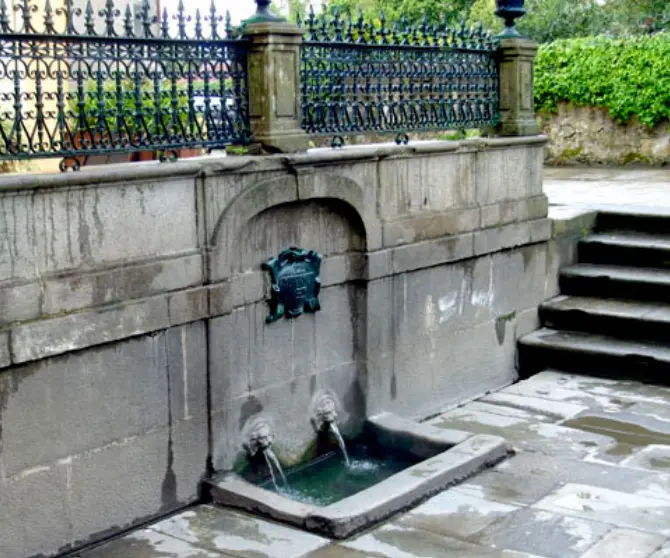
Currently it has a two-spout public fountain built by the city council in 1881, which flows water at about 45 degrees, and two spas, Acuña and Dávila.
Mineral-medicinal thermal water is the most important resource in the birth and development of Caldas de Reis. These waters belong to the group of hyperthermal and bicarbonate sodium-chloride sulphurous waters. From the point of view of medical hydrology, this type of water is, both due to its temperature and its composition, one of the most interesting in the entire mineral-medicinal spectrum.
The waters of Caldas are indicated for conditions of the respiratory system (rhinitis, pharyngitis, asthma, etc.), locomotor (osteoarthritis, arthritis, etc.), and dermatological conditions (psoriasis, etc.), as well as in relaxation cures. (Source: Vademecum II of Spanish mineral-medicinal waters).
The public fountain of A Burga with its typical open-air setting, makes thermal water available to all citizens.
A Tafona thermal pools are located in the park of the same name; in the city center. These are five outdoor pools of different sizes to enjoy bathing as well as a green area to relax or sunbathe.
MORE INFORMATION HERE